The cabin air filter is the cheapest part on your EV and one of the few that affects your range, your windshield, and the air you breathe every day. Here's why it matters more on an electric vehicle, what HEPA actually gets you, and whether your car can be upgraded.
Every car has a cabin air filter. On a gas car it runs when you drive. On an EV it runs when you drive and while you're parked — cabin preconditioning before you leave, Dog Mode at the grocery store, Camp Mode overnight, and a heat pump that cycles the blower to manage cabin and battery temperature. Over a year, an EV's HVAC system pulls far more air through its filter than a gas car ever does.
When that filter loads up with dust, pollen, leaves, and smoke, the blower has to work harder to move the same air. That extra effort comes straight out of the battery. It's a small drain, but on an EV it's one of the very few maintenance items that directly costs you range — and it gets worse in the heating and cooling extremes when you need the range most.
The other thing an EV changes is silence. With no engine noise, a strained blower is the loudest thing in the car, and with a sealed, quiet cabin you notice every bit of pollen and smoke that gets through. A fresh filter is the difference between a cabin that feels new and one that fogs slowly, smells musty on humid mornings, and hisses at you on the highway.
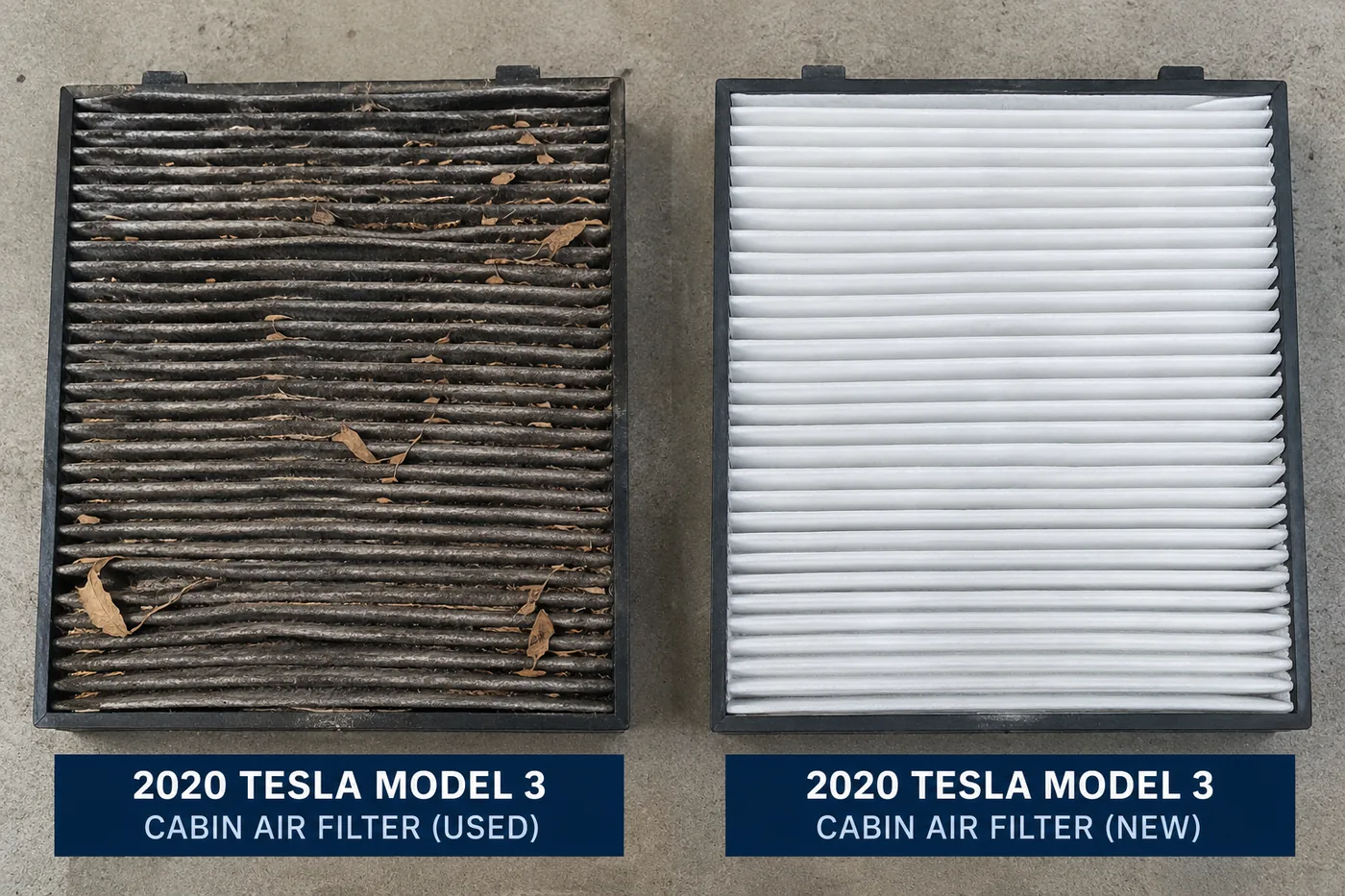
The blower is running hard but the air can't get through the media
Moisture trapped in a loaded filter and a damp evaporator — very common in our wet climate
Defrost depends on airflow volume, and a blocked filter cuts it
In a silent EV cabin, a whistling or straining fan is hard to miss
A saturated filter stops filtering — and can start releasing what it caught
Or one wildfire season — smoke loads a filter faster than anything else
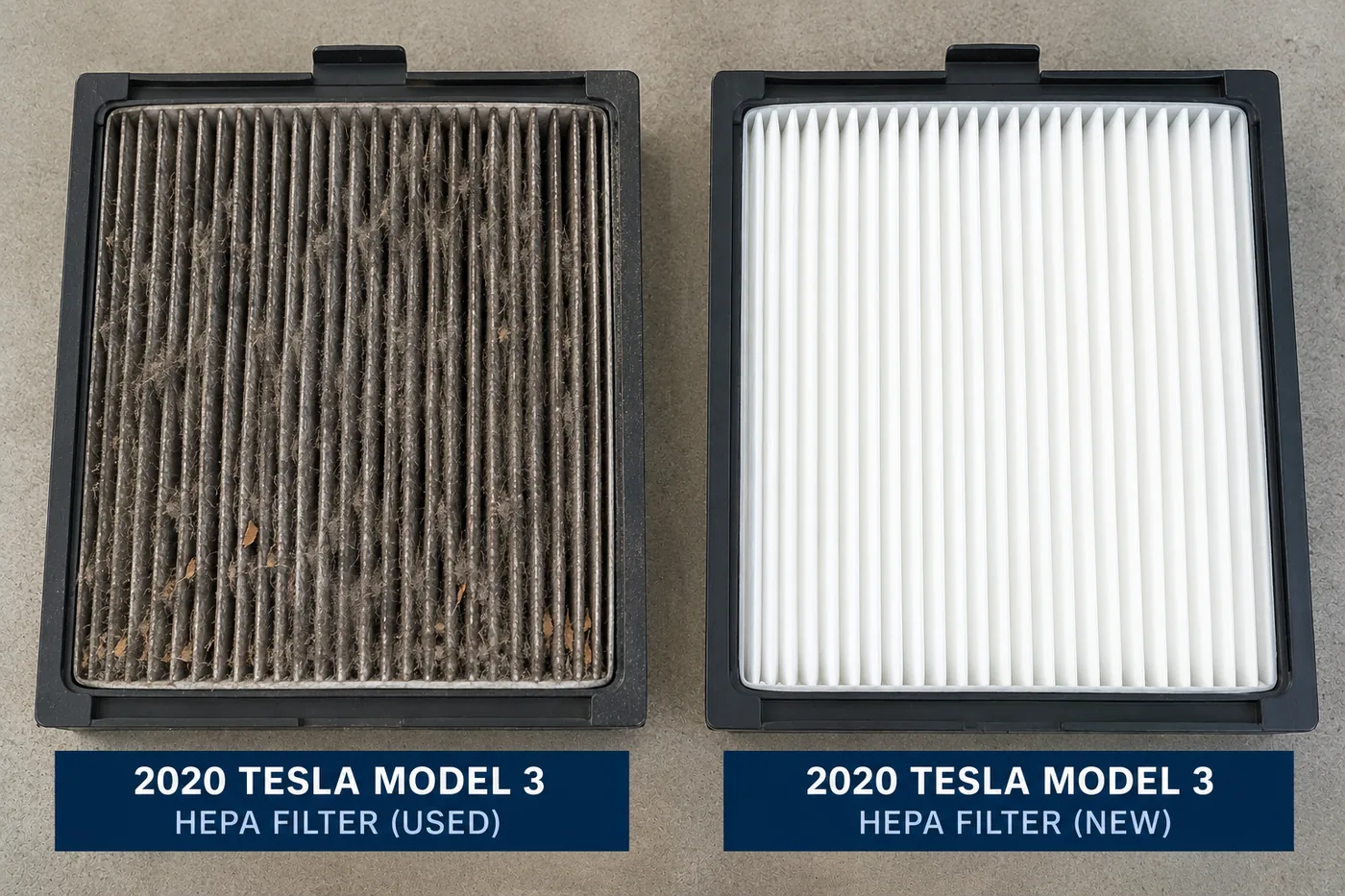
Both filters came out of the same 2020 Tesla Model 3 in our shop, and both were long overdue. What they stop, and what they let through, is where they differ.
Pleated particulate, often with activated carbon
Fitted to: Tesla Model 3, most Model Y builds before late 2021, and virtually every other EV and hybrid on the road.
99.97% of particles down to 0.3 microns
Fitted to: Tesla Model S and Model X (2016+), Model Y built from late 2021 onward, plus a handful of luxury EVs. HEPA cars usually also carry a secondary carbon pre-filter that we replace with it.
Short answer: not to a true HEPA system — but yes to something meaningfully better.
A factory HEPA filter is several times thicker than a standard cabin filter, and the dense media needs a blower sized to push air through it. Tesla builds the HEPA system into its own large housing at the front of the car on Model S, X, and later Model Y. A Model 3, or an early Model Y, simply doesn't have that housing or that blower, so a real HEPA filter can't be fitted, and Tesla doesn't offer a retrofit. The same is true for every other EV that shipped with a standard filter.
What does fit is a premium high-efficiency filter in the standard slot: multi-layer media with an activated-carbon layer that stops a lot more fine particulate and odour than the basic filter the car left the factory with, while still flowing enough air to keep the blower happy. It costs a little more than a basic filter and is the upgrade we recommend for allergy sufferers, anyone who sits in commuter traffic, and every EV owner heading into another BC wildfire season.
One caution: filters sold online as "HEPA" for standard-filter cars are usually just dense media in a thin frame. If the media is too restrictive for the stock blower, you get less airflow, more fan noise, and a strained blower motor. We fit filters that meet the vehicle's airflow spec — better filtration shouldn't cost you defrost performance.
Ask Us About a Filter UpgradeOpen the climate controls and look for Bioweapon Defense Mode. Only HEPA-equipped cars have it. If it's not there, your car uses a standard cabin filter — and a premium high-efficiency filter is the upgrade path.
Manufacturer intervals are a ceiling, not a target. Wildfire smoke, spring pollen, and gravel roads all load a filter early, so we inspect it at every visit and replace it when it's actually dirty. Some hybrids and a few EVs also carry a second small filter on the battery cooling fan intake — we check that too.